Putting a 4–20 mA Plant on a 5G Link
A retrofit design that digitises a pilot plant's analogue loops and carries them over 5G — costed to the ringgit
What
The process pilot plant we had surveyed the semester before transmits everything over analogue current loops. That works, but it fixes the data where the cable goes. This assignment asked what it would take to lift that data onto a 5G network instead — and, unusually for a coursework brief, to say what it would cost.
How
The design starts from what the instruments actually output. Each transducer on the plant senses a physical parameter and produces a current proportional to it, so the first job is mapping every 4–20 mA range onto the physical quantity it represents — differential pressure for the IPC4 converter and the LD301 transmitter, level for the NIVELCO NIVOCAP CTR-110. That mapping is the equation the microcontroller has to carry.
Getting the signal off the plant. The transmission path we proposed is Radio-over-Fibre. Analogue signals are converted to RF, modulated onto an optical carrier and sent down fibre to a central processing facility, where they are converted back to RF and digitised. Fibre is what keeps the loss and the interference down over distance.
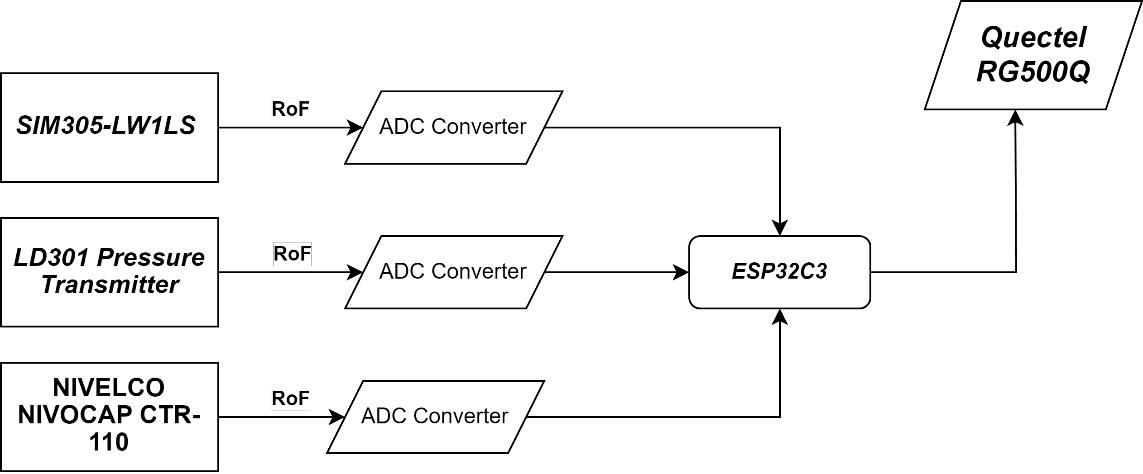
Two ways to do the conversion, and a real trade-off between them. The first design routes each transmitter through its own ADC into an ESP32-C3 — a RISC-V part with a 12-bit ADC, 400 kB SRAM, 4 MB flash and Wi-Fi and Bluetooth built in — which then feeds a Quectel RG500Q 5G module. The honest objection to it is that the ESP32-C3 is a small microcontroller and may struggle with several digital inputs at once. So the second design uses an ADUC7060 instead: an ARM7TDMI part specialised for data acquisition, with a high-precision 24-bit sigma-delta ADC built in, up to 62 kB flash and 8 kB SRAM.
The conclusion we drew was not that one wins. The ADUC7060 buys accuracy where sensor data acquisition is the priority; the ESP32-C3 buys integrated wireless and a simpler design where connectivity is the priority.
Outcome
A complete retrofit design with both options drawn as operational flowcharts, and a bill of equipment: RM33.50 for the ESP32-C3, RM24.82 for the ADUC7060, RM2,101.50 for the 5G module, RM3,000 for the optical transmitter/receiver and RM100 for the fibre — RM5,259.82 in total.
Writing the cost table was the part that changed how the design read. Up to that point the 5G module and the microcontroller felt like comparable decisions; the table shows the microcontroller choice is a rounding error against the optics, which is where a real retrofit would have to be argued.
Gallery
Click any image to enlarge