RASS — Roll Angle Stabilisation for an Autonomous Motorcycle
A teaching aid where velocity and centre-of-gravity height are live sliders — and either one can push the loop into instability
What
A simulation-based teaching aid for control systems students, built around a real question: how does an autonomous motorcycle — with no rider to lean — stay upright? Our answer was RASS, a Roll Angle Stabilisation System that shifts the machine's centre of gravity to hold the roll angle.
The brief required a second-order-or-higher system demonstrating both open- and closed-loop control across at least three course topics. We took time-domain analysis, stability analysis and steady-state error analysis.
How
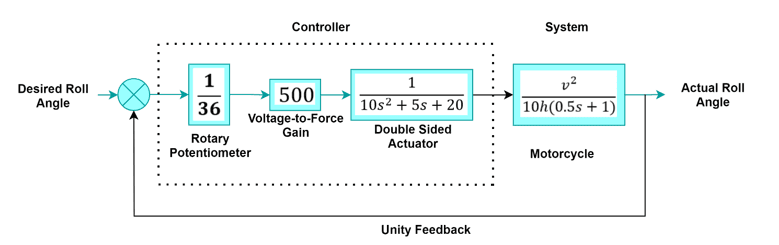
The plant is modelled as a chain from desired roll angle to actual roll angle: a rotary potentiometer, a voltage-to-force gain, a double-sided actuator and the motorcycle itself, closed with unity feedback. Two of the terms in the motorcycle block carry the physical parameters we wanted students to be able to move — forward velocity v and centre-of-gravity height h.
Time domain. Open loop gives a rise time of 0.9353 s, settling time 19.9513 s, peak time 2.5546 s and 53.8574% overshoot; assuming second-order dominance, ζ = 0.1933 and ω = 1.2534 rad/s. Closing the loop gives 0.8628 s, 27.2321 s, 2.4301 s and 61.8862% overshoot, with ζ = 0.1510 and ω = 1.3078 rad/s. Faster to rise, slower to settle, and more overshoot — not the improvement a student expects from "closed loop is better", which is exactly why it is worth showing.
Stability. The open-loop system has poles at 0 + j0, −2.1272 + j0 and −0.1864 ± j1.4738. The pole at the origin is the whole story: not every pole is in the left half-plane, so the open-loop system is unstable. Closing the loop moves them to −2.0684 + j0, −0.1344 ± j1.4302 and −0.1627 ± j0 — all in the left half-plane, and the system is stable. That is the lesson the aid exists to make visible.
Steady-state error. Unity feedback, system type 0, with a step error constant of 0.8711 — so a step input leaves a finite error and a ramp cannot be tracked at all.
What makes it a teaching aid rather than a report is that v and h are sliders. Raise the velocity and the response degrades until, at 8.98, it diverges outright. Drop the centre of gravity to 1.00 and it diverges too. Students find the stability boundary by moving a slider instead of being told where it is.
Outcome
A working MATLAB Live Script and a video walkthrough, assessed on workability, complexity, creativity, presentation and interactivity.
The improvement we put forward at the end was deliberately unglamorous: the system's time constant is the limiting factor, and fixing it is a mechanical problem before it is a control one. Some of what a control loop cannot do has to be handed back to the people who design the machine.
Gallery
Click any image to enlarge