Instrument Survey of a Level Process Pilot Plant
Working principles and static characteristics of the pressure, flow and level instruments on a SIM305-LW1LS plant
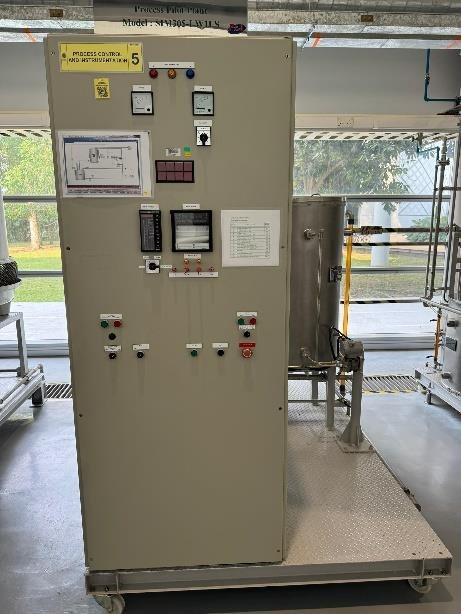
What
A survey of the instruments on a liquid-level process pilot plant — a self-contained rig that emulates the flow and level loops of a real manufacturing plant at a scale you can walk around. For three measurement parameters — pressure, flow and level — the task was to identify the device, explain how it actually works, and state the static characteristics that bound what it can be trusted to tell you.
How
The plant is built around two process tanks. Water is supplied to VE-420 and collected by the source tank VE-410; pump P-412 returns it from VE-420 to VE-410, with manual valve HV-420 setting the flow. A level indicator outside VE-420 gives the operator a direct visual reading alongside the transmitted signals.
Pressure is handled by a Series IPC4 current-to-pressure transducer, which converts a standard 4–20 mA signal into a proportional pneumatic one. It works on the force-balance principle: the input current moves a coil inside a permanent magnetic field, which applies or diverts supply pressure at the outlet nozzle. A sensitive amplifying relay in the pneumatic unit is what buys the accuracy. Its characteristics: accuracy 1% of range span, sensitivity 0.2%, repeatability 0.5% and linearity 0.5% — each of which we set out in terms of what it means for the reading rather than as a specification line.
Flow and level both come from LD301 pressure transmitters, the same device doing two jobs. As a flow transmitter it reads the pressure difference across a primary element; as a level transmitter it reads hydrostatic pressure, which calibration ties to liquid height. Its accuracy is ±0.075% for 0.1 URL to URL, stability ±0.1% of the URL over 24 months, with a minimum span of the transmitter range divided by 120 and a tolerance of 24% deviation on the range limits.
My share of the report was the pressure and level sections, and photographing the instruments in place on the plant — which turned out to matter, because several of the devices look identical and are distinguished only by where they are mounted and what they are piped to.
Outcome
A reference document that connects each instrument to its principle of operation and to the numbers that bound it. The part I use most since is the habit of reading a static characteristic as a question about the measurement — what is the largest error this reading could be carrying? — instead of as a number on a datasheet.
Gallery
Click any image to enlarge