15.7 MWp Floating Solar PV System at UTP
Full preliminary design delivering 24.3 GWh/year — around 51% of campus demand
What
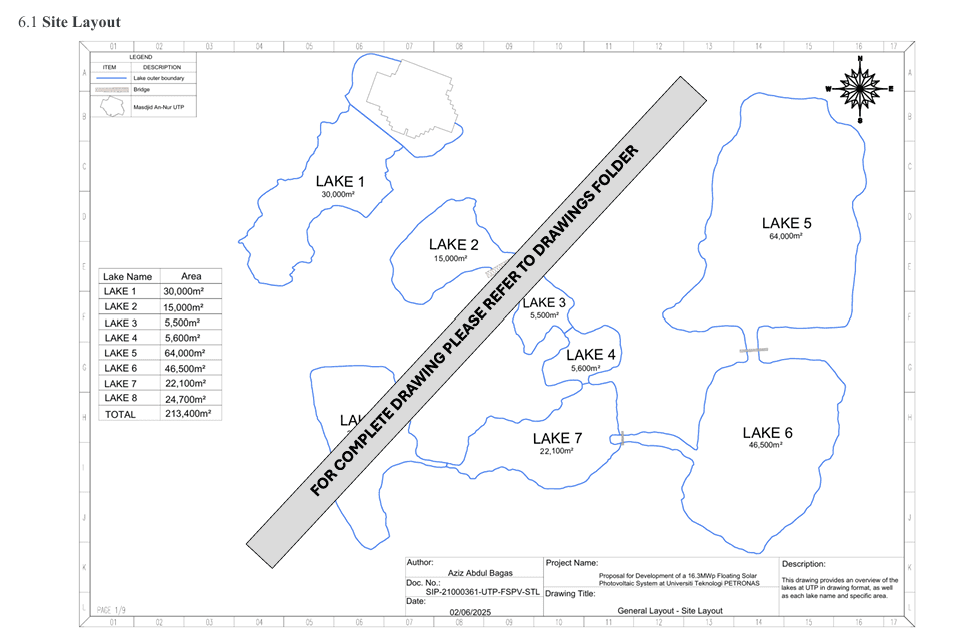
A complete preliminary design and feasibility proposal for developing floating solar across UTP's underused lakes. The premise: the campus cannot spare land for ground-mounted PV — it is needed for educational expansion — but has 220,600 m² of water surface sitting idle alongside an existing 7.4 MWp rooftop system that already covers about a quarter of demand.
How
Site assessment first. Drone survey of all eight lakes, lake-shape change traced through Google Earth imagery from 2018 to 2025, in-situ pH testing per lake (measuring 6.6–8.0, assessed for corrosion rate and material lifetime), water hardness and TDS testing, and depth/bathymetry survey by kayak — establishing 213,400 m² of genuinely usable surface out of 220,600 m² total.
Electrical design. String sizing for a 1500 Vdc system with NEC 690.8 voltage-correction factors; combiner-box sizing; DC cable sizing to MS1837:2018 and IEC 62738 with IEC 62930 temperature and grouping derating (CCC 37.35 A against an Isc of 18.4 A); a 3% voltage-drop limit yielding a 190.57 m maximum string run; and earthing conductor sized by IEEE Std 80-2013 to 47.95 mm².
Structural and marine design. A full environmental load stack for the anchoring and mooring system — wind load from ASCE peak velocity pressure (qz = 435 Pa, Exposure D, gust factor 0.85) giving 243 kN per array; current load from the drag-force equation at 20.4 kN; wave load via Morison's equation at 35 kN on a 1.41 s wave period; combined at the DNV-RP-0584 factor of 1.35 to a design load of 403 kN per direction. That resolved into 76 anchor points, 76 mooring lines and 32 anchor blocks, with steel-wire-rope capacity of 204 kN per line against 20–22 kN expected. The layout was iterated from an initial "poor" configuration to an enhanced one specifically to even out force distribution.
Components and yield. The full system specifies 22,110 Trina Solar 710 Wp modules (TSM-NEG21C.20), 50 Sungrow combiner boxes, 3 central inverters (SG4400UD-MV) and 283 anchoring points across the eight lakes, on PVS-16MH floaters, with first-year performance simulated in PVsyst. Lake 5, the largest array, was carried through in full as the worked example: 7,200 modules, a 403 kN design load per direction, 76 anchor points and 76 mooring lines. Project delivery was tracked on a Gantt chart with milestones and a baseline-versus-actual S-curve across 17 weekly reporting points.
Outcome
24.3 GWh per annum, covering roughly 51% of UTP's electricity demand — which combined with the existing rooftop system takes the campus to about 75% renewable — and avoiding 14,580 tonnes of CO₂ every year. Presented at the Summer Solar site in Kampar and closed with three costed recommendations: solar roofing over the central inverters, DC boosters to cut transmission losses, and extending coverage over the water treatment plant.
Gallery
Click any image to enlarge