EZPark — Cost-Efficient Autonomous Parking System
Autonomous vehicle with live MQTT telemetry, computer vision and self-parking
What
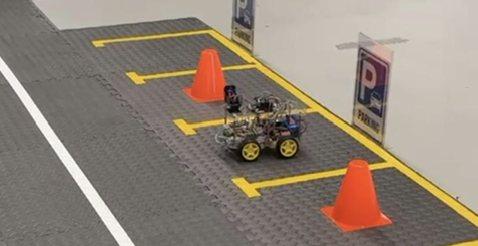
A small-scale autonomous vehicle that follows a route, reads road signs, avoids obstacles, parks itself in a designated bay, and reports everything to a live dashboard with two-way control — plus a solar charging station. Built as an affordable proof of concept for real autonomous parking, against the problem of drivers circling for spaces in dense commercial and residential areas.
The system is split into four integrated subsystems: ANC (navigation and control), ITP (image transmission and processing), EC (energy and charging) and ODD (online data display), which was mine.
How
The ODD subsystem was architected in four layers.
Data acquisition — two INA226 modules for voltage and current, an MPU-9250 for acceleration, and an AS5600 magnetic Hall encoder for speed. The AS5600 was selected over the higher-resolution AS5048A and the AEDR-8300 optical encoder for robustness in a dusty robot environment; simply inferring speed from the motor PWM setting was tested and rejected as inaccurate. Linear velocity is derived as v = πD·N/t. Battery level and distance travelled are derived from the same sensors rather than adding hardware, and signal strength is read from the ESP32's own RSSI.
Wireless communication — MQTT over HiveMQ, chosen after latency benchmarking against HTTP REST (2–4 s) and WebSocket (1–2 s), and for its publish/subscribe model, which allows user-to-vehicle commands rather than telemetry in one direction only. Deployed as a hybrid local-plus-cloud topology so a live demo survives Wi-Fi loss while the same data still mirrors to cloud for history and remote access.
Data processing — a Node-RED flow (selected over Blynk, ThingsBoard and Grafana on cost and cloud-integration simplicity) performing validation, formatting, timestamping, and CSV plus AVI generation. JSON payloads at an empirically tuned 1 Hz refresh rate — fast enough to be real-time, slow enough to avoid congestion.
Visualisation and storage — line charts, numeric and level indicators, a live video feed, pop-up status alerts, and START / STOP / DISABLE control buttons.
Elsewhere in the system. ANC ran a PID line-follower (Kp 40, Ki 0, Kd 20) on an ESP32 with an L298N driver and four DC motors; ITP ran YOLOv11s trained on 2,120 images across five classes (arrow, bump, cone, OKU, parking) for 120 epochs on a Colab Tesla T4, streaming from an ESP32-CAM.
Outcome
A fully integrated working vehicle. Line-following was stable on both straights and corners; sign-triggered bump slowdown and the autonomous parking manoeuvre both executed successfully in testing; and MQTT START/STOP commands published from the dashboard were received and acted on in real time with no missed commands under normal network conditions. The final demo produced a complete telemetry dataset and synchronised video recordings. Delivered as Capstone Day posters for 2025 and 2026, two technical reports and a demonstration video.
Gallery
Click any image to enlarge