Three-Phase Induction Motor Overhaul
Diagnosed, rewound and recommissioned a failed motor back to within 5 rpm of synchronous speed
What
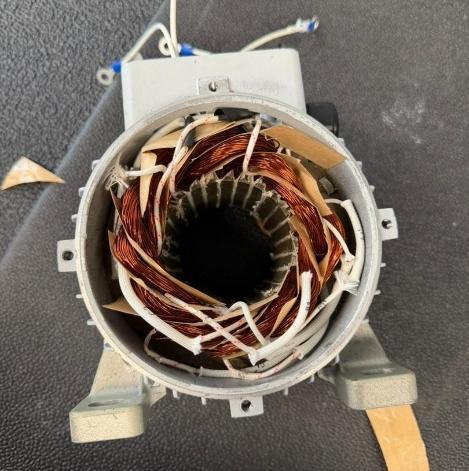
Diagnose, strip, rewind and recommission a failed 0.75 kW (1 HP) four-pole squirrel-cage induction motor — 380 V, 2.2 A, 1400 rpm, 50 Hz, three-phase — then quantify the recovery against pre-overhaul baselines. The motor arrived with no nameplate attached, so its ratings had to be established from inspection and measurement before any work began.
How
Diagnosis first. Synchronous speed was computed as Ns = 120f/P = 1500 rpm, giving a rated slip of 0.0667 as the performance benchmark. Insulation resistance was measured phase-to-phase (7.98–13.97 GΩ) and phase-to-ground (3.37–15.40 GΩ) alongside winding continuity (U 8.9 Ω, V 8.7 Ω, W 10.3 Ω). All values read "excellent" against the conventional 100 MΩ threshold — but the W-phase imbalance (15.40 GΩ to ground, some 4.5× the other phases, with matching elevated winding resistance) localised the fault. Under load test the motor stalled at 1 rpm drawing 1.94–2.31 A at only 80 V; above that, current exceeded the 2.2 A nameplate limit and the test became unsafe. All input energy was dissipating as stator heat rather than producing torque.
Then the overhaul, across five lab sessions: full disassembly and cleaning of every component, the old winding recorded and stripped, new slot insulation prepared and cut, the stator hand-rewound and the coils inserted, terminations made in the correct phase configuration, reassembly, and full re-test.
Two findings were engineered around rather than glossed over. The rewind had to drop from 100 to 80 turns per coil to physically fit the available slot space — accepted and documented as a 0.8 torque ratio, since fewer turns weakens the field and reduces electromagnetic torque production. And several loose stator core laminations were found during inspection, temporarily reseated by pressing, with proper core repair recommended in the report since increased eddy-current loss, vibration and insulation risk will otherwise recur over time.
Outcome
The motor was fully recovered. Its testable range rose from 80 V to 300 V — limited thereafter by the supply's own protection tripping, not by the motor — with speed climbing to 1,495 rpm, within 5 rpm of the 1500 rpm synchronous speed.
Phase currents returned tightly balanced and scaling proportionally with voltage: 0.90 / 0.82 / 0.91 A at 100 V and 2.82 / 2.55 / 2.77 A at 300 V, against pre-overhaul stall currents of 1.94 / 2.31 / 2.09 A at just 80 V. Delivered as a long-format report with speed–voltage and current–voltage characteristics, plus a group presentation.
Gallery
Click any image to enlarge